












There’s a version of the Arkansas offseason story that writes itself practically every year.
New energy, upgraded roster, promising spring, reason to believe. The Razorbacks got better. Ryan Silverfield worked hard. The portal haul landed in the top 10 nationally.
None of that is wrong.
But there’s a version of this story that doesn’t get told nearly as often, and it’s worth asking why.
If you’re counting on somebody to mention that Arkansas drew arguably the toughest schedule in the SEC this fall, you might be waiting a while.
Ticket sales don’t move when people talk about road trips to Kyle Field and Austin in the same breath.

The honest version of this offseason starts with what the Hogs actually face.
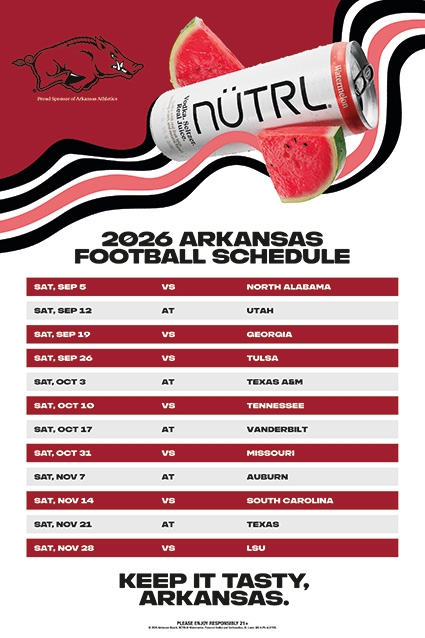
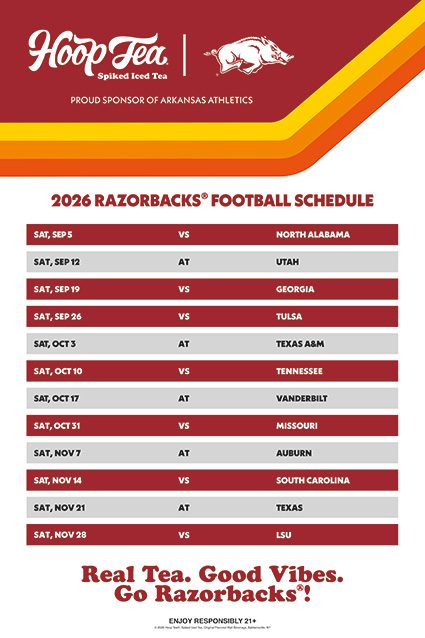
Georgia comes to Fayetteville in Week 3. Texas A&M follows on the road in Week 5. Tennessee shows up at home the week after that.

The Razorbacks then travel to Vanderbilt, host Missouri after a bye, go to Auburn, close out with a trip to Texas and then welcome LSU for the Golden Boot finale.
Six of the nine SEC opponents landed in the way-too-early top 25. That’s not a tough stretch. That’s the whole thing.
CBS Sports ranked the six new SEC head coaches by schedule difficulty and put Silverfield at the top of the list.
Not because they don’t like him. Because math.
The “everybody improved” problem nobody mentions
Here’s the part that doesn’t fit neatly into a preseason hype package. The narrative that Arkansas got better in Silverfield’s first offseason is true.
It’s also functionally incomplete. Every program in the country is projecting improvement right now.
Not one single team enters a season announcing they expect to be worse. The competition didn’t sit still while the Razorbacks rebuilt.
Silverfield’s transfer portal class ranked No. 10 nationally and No. 4 in the SEC, which is genuinely impressive for a first-year coach inheriting a 2-10 roster.

The Hogs landed 41 additions against 37 departures, prioritizing depth and positional competition over headline names.
Cornerback Omarion Johnson came over as a top-10 portal corner. Former Michigan running back Jasper Parker adds competition behind Braylen Russell. Hunter Osborne arrived from Virginia to help patch a defensive line that had almost nothing returning.
Good players. Real improvements.
But a program that went 0-8 in SEC play last season needed more than plugging individual holes.
Arkansas lost its three leading receivers and leading rusher from 2025 and enters fall camp with a quarterback situation that started the offseason with just one scholarship player before Silverfield stabilized it.
The roster got better. Whether it got better enough to flip results against this particular schedule is a separate question because the depth will factor in sooner or later.
The recruiting math doesn’t lie
The high school piece of the class has a feel-good storyline.
Silverfield signed the top player in Arkansas in defensive tackle Danny Beale within hours of being introduced.

He flipped running back Terry Hodges away from Missouri.
Six of the top seven prep additions were in-state players, which is smart program-building and genuinely worth recognizing.
But the class still trails most of the SEC when ranked by commitment rating alone.
ESPN gave the class generous marks for the circumstances, placing it second nationally among programs that changed coaches.
That’s a real accomplishment given how late Silverfield arrived.
It’s also a reminder that the bar was set against other rebuilding programs, not against Georgia or Texas.
The roster has more bodies and more competition than a year ago. It doesn’t yet have the kind of depth that handles attrition in a nine-game SEC schedule without feeling it.
What the schedule actually demands
The 2026 slate opens with North Alabama and Tulsa, two games the Razorbacks should handle, before walking directly into Georgia at home in Week 3.
That’s not a soft landing for a first-year staff. That’s a trial by fire with a program that’s made the College Football Playoff in back-to-back years.
Road games at Texas A&M, Vanderbilt, Auburn and Texas are not the kind of trips that build confidence early.
Arkansas hasn’t played at Vanderbilt since 2011, and the Commodores just came off their first 10-win season in program history. That road game in Nashville that looks manageable on paper carries some big risk.
The most realistic path to a bowl game runs through Vanderbilt on the road, Missouri at home after the bye and South Carolina in Fayetteville.
Even that combination requires things to go right.
The Hogs are underdogs in most of their SEC matchups and haven’t won a conference game since October 2024.
The gap between growth and wins
None of this is a criticism of Silverfield’s effort.
He inherited what his own athletic director described as a program nowhere near ready to compete in the SEC. Of course he also admitted he didn’t provide the resources to build a roster that projects as at least competitive.

The spring reports were encouraging. That’s mainly because they always are with the media these days.
The staff brought real coaching experience and a clear system. The energy in Fayetteville feels different than it did 12 months ago.
But improvement and wins are different things, and the schedule is indifferent to effort.
The Razorbacks can play better football than they did in 2025, show real development at quarterback and tighten up the secondary, and still find themselves in the same bowl eligibility conversation they’ve been having for three years.
That’s the story that doesn’t move tickets.
It’s also the one that matters most right now.
Key takeaways:
- The schedule is the story. Arkansas faces one of the SEC’s most demanding 2026 slates with six conference opponents who landed in the way-too-early top 25, including Georgia, Texas A&M, Tennessee, Texas and LSU.
- Silverfield’s offseason was real, but relative. The Razorbacks legitimately improved their roster through the portal and high school recruiting — but so did every program they’ll face, and the gap between upgrade and conference wins is wide.
- Bowl eligibility is genuinely hard to project. The most realistic path to six wins requires things to break right against Vanderbilt, Missouri and South Carolina, with little margin for error across a nine-game SEC schedule that offers almost no soft stretches.