








College Football playoffs, tales of early fatherhood, appreciating the Valley Girl Soundtrack and more on Arkansas Football.
Guests: Grant Hall, Dudley Dawson and Clay Henry!
College Football playoffs, tales of early fatherhood, appreciating the Valley Girl Soundtrack and more on Arkansas Football.
Guests: Grant Hall, Dudley Dawson and Clay Henry!
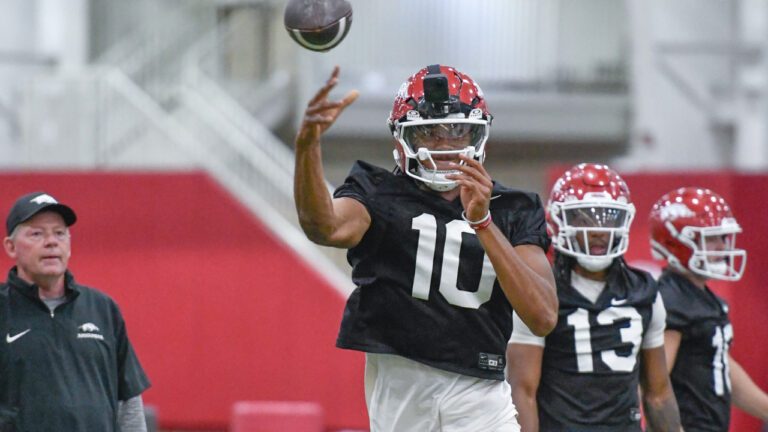
While Alabama A&M projected to be a win, Hogs need to get out of the gate fast and put questions to rest early in season opener.

Tye & Tommy discuss their beefs, NIL vs schedule, Richard Davenport plus Auburn declaring championships
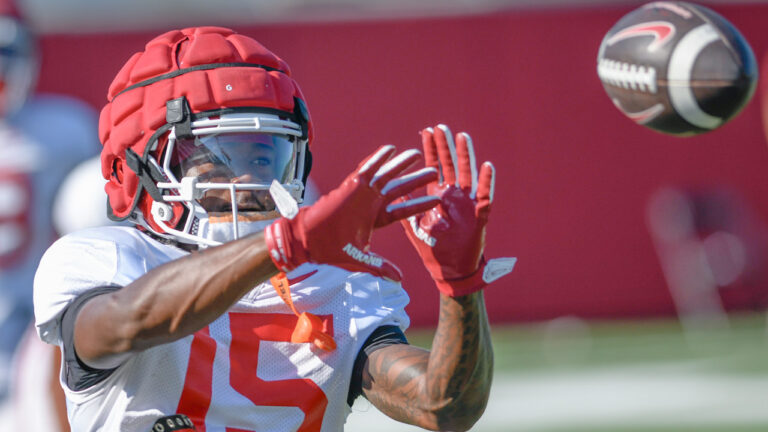
FAYETTEVILLE, Ark. — Kam Shanks, a transfer wide receiver and return specialist from UAB, is expected to play a big role for Arkansas this fall.
The hope is he’s bringing speed and versatility to both the offense and special teams.
Shanks, a 5-foot-9, 168-pound redshirt sophomore, led the nation in punt return yards last season with 329, averaging 20.6 yards per return and scoring two touchdowns.
He was named first-team All-AAC as a return specialist and third-team All-AAC as a receiver, finishing the 2023 season with 62 receptions for 656 yards and six touchdowns for the Blazers.
On Nov. 5, Shanks produced 311 all-purpose yards in a 59-21 win over Tulsa, earning Hornung Award National Player of the Week honors. He also caught five passes for 31 yards and a touchdown against Arkansas in a 37-27 loss at Razorback Stadium.
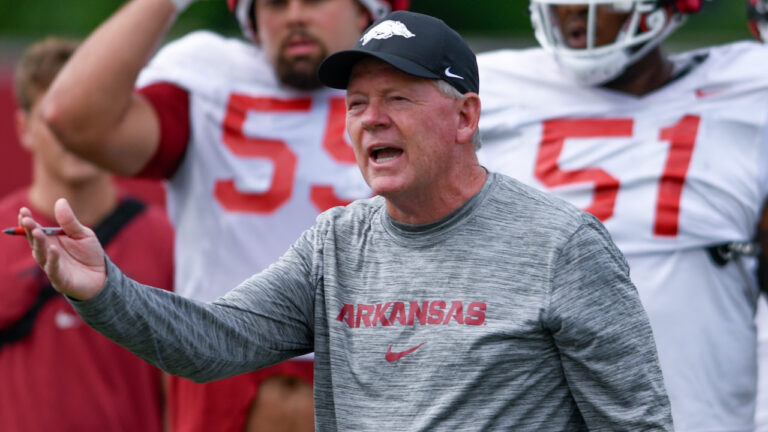
Arkansas offensive coordinator Bobby Petrino said Shanks’ skill set allows him to outperform his size.
“He’s little, but he doesn’t play little because he can elevate and turn his body,” Petrino said Tuesday. “Short guys that can’t jump and turn in the air are hard targets to hit, but you can actually throw him open and he’s able to elevate and turn and make those catches.”
Petrino said the coaching staff is working to integrate Shanks into the offense, focusing on timing and chemistry with the team’s quarterbacks.
“It’s nice to have him back out there because we need the time with the quarterbacks working with him to understand where he’s going to be, what his quickness gives us, because he’s super quick, and he’s a hard matchup because of that quickness,” Petrino said.
Shanks has earned several preseason honors, including spots on the Jet Award and Hornung Award watch lists. He was named preseason first-team All-SEC by Phil Steele, and first-team All-American by The Sporting News and Athlon Sports, all as a return specialist.
Arkansas special teams coach Scott Fountain said the decision to pursue a dedicated punt returner in the transfer portal was a priority this offseason.
“If you watch Kam’s film last year, he had three house calls in one season. One got called back, so it got annulled, but he was impressive and did some good things,” Fountain said. “He had no returns in our game, so that was a good thing. But we were worried about him going into the game, concerned about him.”
Fountain said he hopes the addition of Shanks will improve a special teams unit that has struggled in recent seasons.
“I love to return punts. I’ve had a lot of good punt returners in my career, and I really hope this would be an exciting year for us in that area,” Fountain said.
Petrino compared Shanks to former Arkansas standout Joe Adams, who won the first Jet Award in 2011 after scoring four punt return touchdowns.
“His quickness as a receiver and his toughness, that would remind me a lot of Joe,” Petrino said. “Joe was unbelievably quick, change-of-direction, stop and go, and then tough and enjoying running the ball. When you’ve got that mental toughness, it helps a lot.”
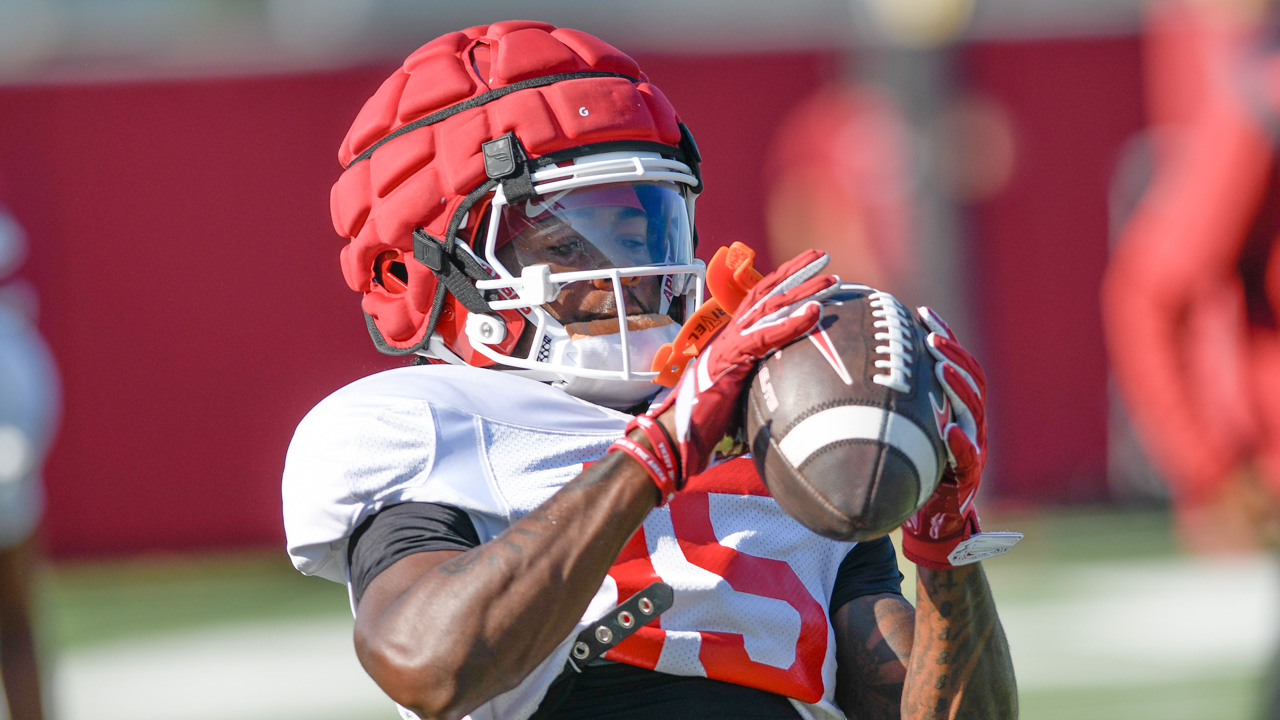
Shanks’ transfer to Arkansas was part of a larger effort to retool the Razorbacks’ offense. After his successful season at UAB, he attracted interest from several Power Five programs before choosing Arkansas. Hogs coach Sam Pittman and the staff have emphasized Shanks’ potential role in a more dynamic offense.
Shanks has spent the offseason developing rapport with Arkansas’ quarterbacks and learning the Razorbacks’ system. The team hopes his quickness and ability to create separation will provide a needed spark to the offense, which struggled with consistency last season.
The Razorbacks are coming off a 7-6 season. The addition of Shanks is expected to boost both special teams and offensive production. As the season approaches, Shanks will be watched closely as he transitions to SEC competition.
It could fill a big hole in something the Hogs have been missing for awhile on a consistent basis.
CALL or TEXT 877-377-6963! Join the conversation!
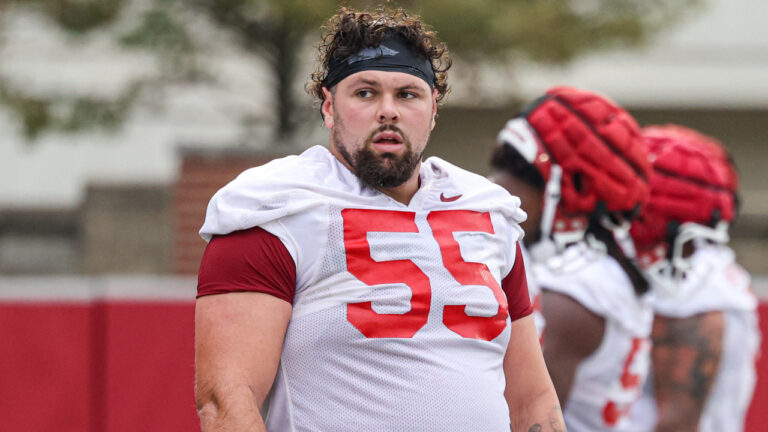
FAYETTEVILLE, Ark. — Arkansas offensive lineman Fernando Carmona Jr. and defensive tackle Cam Ball have been named to the Preseason All-SEC teams by the league’s coaches, the league announced Tuesday.
Carmona, a senior and transfer from San Jose State, was selected to the All-SEC First Team after starting every game at left tackle for the Razorbacks last season.
Ball, a senior from Atlanta, was named to the Third Team following a breakout 2024 campaign in which he recorded a career-high 47 tackles, including four tackles for loss and 1.5 sacks.
Ball, who joined Arkansas in 2021, is expected to start on the defensive line this season. He said he turned down offers from other programs after the 2024 season, opting to remain with the Razorbacks.
“I had opportunities to leave, but it was no point to just pack up and go for a matter of a year or so, and lose all the connections and relationships I built in this state,” Ball said last week. “The people. I love the people here in Arkansas. Not only in Fayetteville, but I’ve been all around Arkansas and I just love this state in general.”
Carmona moved from left tackle to left guard this offseason, making way for transfer Corey Robinson II. The coaching staff praised his adaptability and experience.
“Fernando’s one of those guys you just trust,” Arkansas coach Sam Pittman said. “He brings experience, but it’s his leadership that sets the tone for the whole offensive line.”
Ball’s decision to stay at Arkansas was significant for a program that has seen several players depart via the transfer portal in recent years.
“Cam’s presence means everything to our defense,” defensive coordinator Travis Williams said. “He’s the heartbeat up front and a mentor to the younger guys.”
The Razorbacks finished 4-8 last season and are looking for improvement as Pittman enters his fifth year as head coach. Arkansas opens its season Aug. 30 against Alabama A&M at Razorback Stadium, with kickoff scheduled for 3:15 p.m. on the SEC Network.
Both Carmona and Ball are in their final seasons of eligibility. Carmona was named SEC Offensive Lineman of the Week twice in 2024 and was selected to the Outland Trophy watch list. Ball has played in 37 games at Arkansas, starting 17.
The SEC preseason teams are determined by votes from the league’s coaches ahead of each season. Coaches are not allowed to vote for their own players.
Arkansas will look to its veteran leaders as it navigates a challenging SEC schedule that includes games against LSU, Alabama, and Texas A&M.
“It’s great to be recognized, but I’m here to win games,” Carmona said. “That’s the only thing that matters, what we do as a team.”
The Razorbacks’ preseason accolades highlight key players as Arkansas seeks to rebound and compete in the SEC this fall.
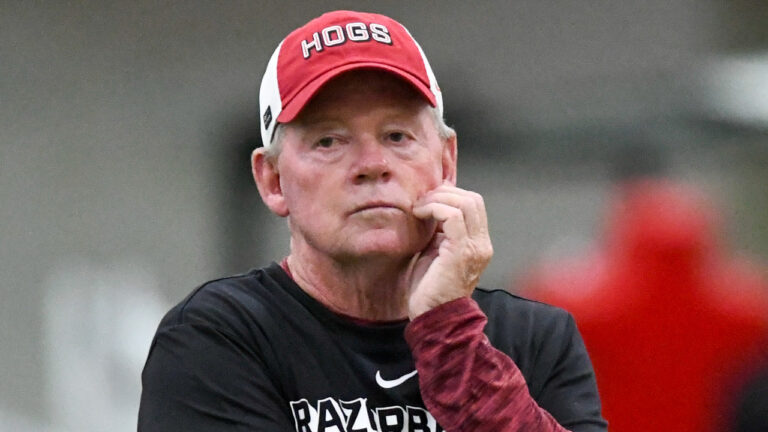
FAYETTEVILLE, Ark. — Now Arkansas goes into full preparation mode for the season.
They will be doing it with a rebuilt wide receiver corps, featuring a mix of new transfers and returning players after losing the team’s top six pass catchers from last year.
You might want to get a program just to know who’s out there on the field in what number, too. There are a lot of new faces.
Offensive coordinator Bobby Petrino said the receiver competition remains open as the team turns its attention to game preparation.
“It’ll probably be this week [it starts] working itself out a little bit more,” Petrino said. “You go into some situation work this week and game plan stuff and still go ones versus ones, so you get that competition.”
The Razorbacks added several transfers, including O’Mega Blake, Raylen Sharpe, Kam Shanks and Jalen Brown, to bolster depth and speed. Jalen Brown, a transfer from LSU, has earned praise from Petrino for his speed and improved understanding of the offense.
“J. Brown had a big day. I thought he felt good about it. He looked fast out there. And the thing about him is he is fast. So as long as he knows exactly what he’s doing, he’s going to play like that,” Petrino said.
Returners Monte Harrison and CJ Brown have also emerged as key options. Harrison, 30, spent a decade in professional baseball before walking on at Arkansas this summer.
Petrino said Harrison’s athleticism stands out.
“He just pops off the board and you’re going, ‘This is unbelievable how talented this young man is, or old man is.’ … But he is an unbelievable talent. Now he understands football. He’d been away from it for a long time, so he’s done a great job for us so far. We gotta keep it going,” Petrino said.
C.J. Brown, who saw limited action last season as a freshman, has impressed Petrino with his versatility and preparation.
“He started getting involved in the offense late in the season,” Petrino said. “Right now, he’s playing two different positions for us and his skill set, his quickness is really good inside, but he also has the really nice speed and routes that he can hit on the outside. The quarterbacks feel good about where you’re going to be on the deep throw, so he’s going to have a good year for us.”
The Razorbacks are also counting on Shanks, a 5-foot-8 transfer from UAB, for both special teams and matchup advantages at receiver.
“He’s little, but he doesn’t play little,” Petrino said. “He doesn’t play little because he can elevate and turn his body. Short guys that can’t jump and turn in the air are hard targets to hit, but you can actually throw him open and he’s able to elevate and turn and make those catches.”
Blake, a graduate transfer, has been limited in opportunities but remains in the mix. Sharpe, who has dealt with injuries, could return to add further depth as the season progresses.
Arkansas quarterbacks, including Boise State transfer Taylen Green, are working to build chemistry with the new-look receiver group as the team prepares for its season opener against Alabama A&M on Aug. 30.
Projected depth charts list O’Mega Blake, CJ Brown, and Raylen Sharpe as likely starters, with Kam Shanks, Monte Harrison and Jalen Brown providing additional options.
Coaches have indicated that the receiver rotation is still evolving with several practices remaining before kickoff.
Petrino, in his second season of his current stint with the Razorbacks, said the focus is on building consistency and timing in the passing game after a year of transition at the position.
“It’s nice to have [Shanks] back out there because we need the time with the quarterbacks working with him to understand where he’s going to be, what his quickness gives us, because he’s super quick, and he’s a hard matchup because of that quickness,” Petrino said.
Now they’ve just got to get it all to work in a game.
The season opens Aug. 30 against Alabama A&M at 3:15 p.m. The game will be televised on SEC Network.
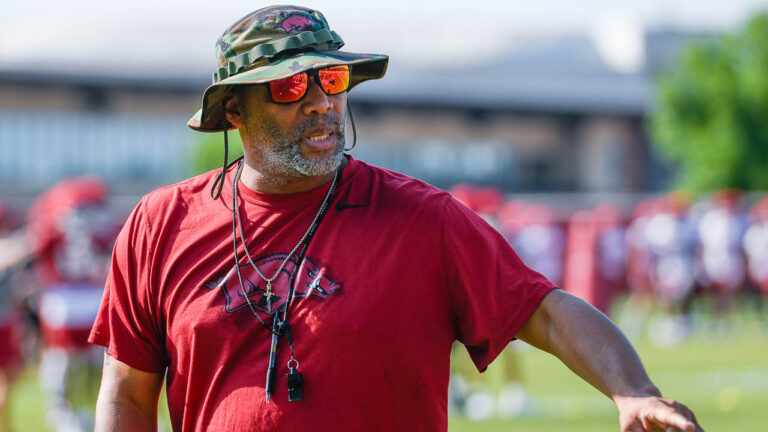
After injury in defensive line, questions leaping out about depth Deke Adams has and opportunities for young players to step up.
Recapping practices as the Hogs closing down camp and getting ready to start pregame preparations for Aug. 30 opener against Alabama A&M.
Did we hear anything from the football program and Pittman this last week? Or is it truly, potato, potahto…?
Guests: Bruce Stanton x Tom Murphy!
HitThatLine.com is the website for ESPN Arkansas. Listen at 99.5 in Fayetteville, 95.3 FM in Fort Smith and the River Valley, 96.3 FM in Hot Springs and 104.3 FM in Harrison.
© Copyright 2017-25 by Pearson Broadcasting. All rights reserved.