











There’s a lobby inside the football center where you can run into a Razorback legend and end up standing there a lot longer than you expected.
That happened to me with Bill Burnett a few years back.
He didn’t look for the exit. There wasn’t just a polite nod and move on. He stood there in that lobby and talked, and it wasn’t forced, and that was just who he was.
He was the same way decades earlier when I was a kid growing up in Warren and seeing him before games.
Bill Burnett passed away Saturday in Fayetteville. He was 78 years old, and he died on the Fourth of July as the country marked its 250th birthday. His daughter, Joy Burnett Irvin, shared the news that night and noted her father went home to be with Jesus on the very day America turned 250.
For those of us who watched him play for the Razorbacks, the news landed hard and fast.

Burnett name meant something before Bill ever carried ball
Growing up in Warren, you knew about Smackover. It’s about 55 miles to the southwest, and the Smackover Buckaroos played the Warren Lumberjacks every season, which meant you knew the names that came out of that program. I played on that field in Smackover.
Bobby Burnett and Tommy Burnett both played high school ball in Smackover before heading to Fayetteville.

Bobby was a running back, and he had that same leaping quality at the line of scrimmage that Bill would later make famous. There was clearly something in that family’s football DNA.
Tommy was a tight end for the Hogs, and he made a big touchdown catch against Texas in Austin in 1966 in a game Arkansas won. His 22-yard scoring reception on a pass from Jon Brittenum proved to the game-winner.
By the time Bill showed up in Fayetteville as the last and youngest of the football-playing Burnett brothers, a kid in Warren already had reason to pay attention to that name.
Bill didn’t disappoint. He became a prep standout at Bentonville High before Frank Broyles got him into a Razorback uniform, and what he did there still hasn’t been matched.
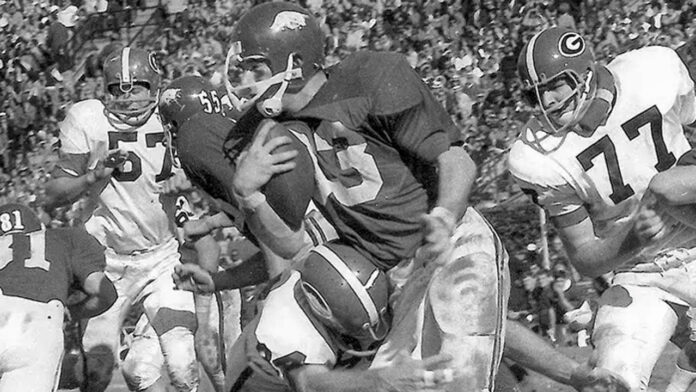
He scored 49 touchdowns during his three seasons in Fayetteville, with 46 of those coming on the ground — both totals still stand as Arkansas program records.
Bill’s frame was was slight, maxing out at 6-foot and 185 pounds with big shoulder pads and a jersey that flew in every direction, even with no wind.
He was elusive and fearless and he knew how to get his body up and over the line when it mattered. His record of 23 consecutive games with a rushing touchdown stood for more than 50 years before Iowa State’s Breece Hall finally broke it in 2021.
You don’t put up numbers like that by accident, and you don’t hold them for half a century without having been something genuinely rare.

War Memorial Stadium and a different kind of access
Getting to go to Razorback games at War Memorial Stadium in Little Rock as a kid in the 1960s was something you didn’t take for granted.
The drive up from Warren wasn’t short. Game days in Little Rock had an energy that didn’t exist anywhere else in Arkansas … not even close.
When the Hogs were good, and under Broyles they were good almost every year, the whole state leaned in.
What few will tell you about that era until you live it is how accessible those players were.
The team rode a bus down from Conway for pregame walk-throughs before home games in Little Rock.
When they left the field for the dressing room up the ramp afterward in street clothes, there was nothing between you and them.
No rope line. Checking for any credential wasn’t going to happen. No PR staff managing the perimeter.
Bill Burnett would come through and you could walk up and ask him to sign a program, a ticket stub or whatever else you had handy, and he’d do it. Bill Montgomery would do it. Chuck Dicus would do it.

They’d stand there and sign and talk, and nobody acted like it was a burden, because it wasn’t.
That kind of thing shapes how you see a player for the rest of your life.
He was real thing on and off field
Bill wasn’t just approachable during the good years. He was that way all the way through.
After his playing career for the Hogs ended and the Baltimore Colts drafted him in the ninth round in 1971, though he never played in the league, he threw himself into building the Fellowship of Christian Athletes across Arkansas at an age when most people his age were still figuring out what came next.
He pioneered those chapters across the state, drove around to high school coaches to get them involved, and became the first full-time paid FCA representative outside of Kansas City. He also opened a Crisis Pregnancy Center in Fort Smith.
Those aren’t the things that make recruiting profiles or TV highlight packages. They’re the things that tell you who somebody actually was when the scoreboard wasn’t running.
His wife Linda, with whom he’d been married for 56 years, believed he’d spent his final years dealing with Chronic Traumatic Encephalopathy brought on by a career’s worth of repeated contact.
He’d been at Clear Creek Memory Care in Fayetteville for more than a year before he died. That detail is its own kind of painful. A man that sharp and that warm, slowly losing his grip on the person he’d always been.

Smith Center lobby and last time I saw him
I thought about all of that standing in that lobby a few years back when he stopped to talk.
Nothing about him read as a guy who’d scored more touchdowns than anyone in Razorback history and was ready to cash in on it. He was just Bill.
Same patience, same warmth, same willingness to give you a few minutes that he’d shown at War Memorial Stadium when kids were asking for his autograph.
A lot of people who become that kind of figure in your childhood turn out to be something smaller when you meet them as an adult. Bill Burnett wasn’t one of those people.
Growing up in Warren, the Razorbacks weren’t just a team you rooted for on the radio or in the bleachers at War Memorial. They were something bigger than that, something the whole region connected to.
Bill Burnett was one of the players who made that connection feel personal, and he kept it personal right to the end.
That’s more rare than any touchdown record, and it lasts longer too.
Key takeaways
- His 49 career touchdowns and 46 rushing scores still stand as Arkansas program records more than 50 years after he last played, and his FBS mark of 23 consecutive games with a rushing touchdown lasted until 2021.
- Brothers Bobby and Tommy both played for the Razorbacks before Bill arrived, making his climb from deep on the depth chart to the program’s all-time touchdown leader a family story as much as a personal one.
- From pioneering the Fellowship of Christian Athletes across Arkansas in his 20s to stopping to talk in a Smith Center lobby decades later, Burnett never cashed in on the star power that was always there for the taking.