










Plus some talk of MLB All-Star game, also in Atlanta on Tuesday night, plus various teams across SEC this season.
That SEC Podcast’s Michael Bratton’s thoughts on Hogs at SEC Media Days
Popular podcaster’s view on all things in the SEC and his projections for the Razorbacks in year where most don’t expect much.
SEC Network’s Paul Finebaum at SEC Media Days on Razorbacks’ prospects
What he thinks of Sam Pittman’s team heading into what many think is a crossroads sixth year coaching the Hogs.
Bud Light Morning Rush Podcast: 7-16-25
LIVE from SEC Media Days! How do YOU feel when an outsider shares their beliefs about your favorite teams?
Guests: SEC Mike and Paul Finebaum!
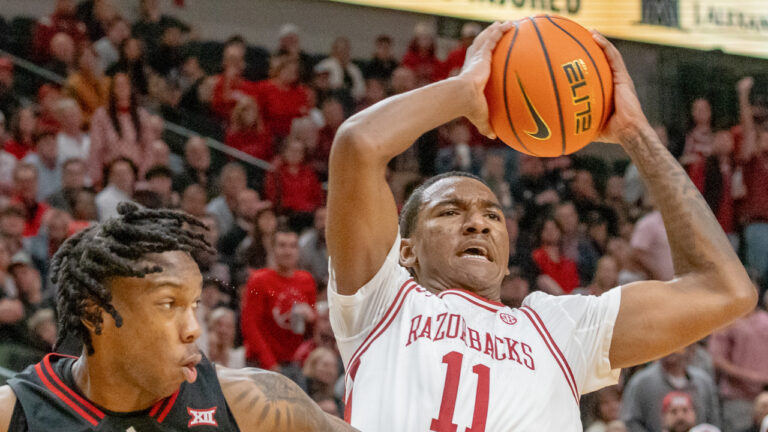
Razorbacks drop Big 12 non-conference game from 2025-26 schedule
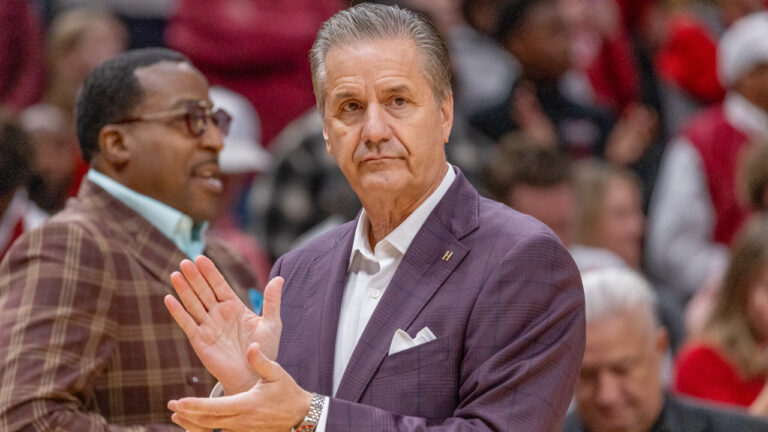
FAYETTEVILLE, Ark. — Arkansas will not face a Big 12 opponent in the 2025-26 non-conference schedule, coach John Calipari confirmed this week.
It’s a shift from the Razorbacks lining up high-profile early contests.
“We’re not playing a Big 12 team in the non-conference this year,” Calipari said at a press conference, addressing widespread speculation after reports surfaced regarding the Razorbacks’ adjusted scheduling philosophy.
While he stopped short of specifying which team was dropped, Calipari’s remarks end weeks of anticipation surrounding the reveal of Arkansas’ complete non-league slate.
This development follows years of marquee non-conference games for Arkansas. Last season, the Razorbacks clashed with Baylor in Dallas as part of the annual Big 12-SEC Challenge, a contest that drew significant regional interest.
With the dissolution of that formal series after conference realignment, the 2025-26 schedule had been expected to feature a carryover match with a Big 12 school, likely either Baylor or Texas Tech.
That, however, will not happen.
Calipari did not elaborate on the reasons for the scheduling change, but sources indicate the decision was influenced by a desire to vary opponents and avoid repetitive regional matchups that have become routine in recent years.
With the SEC expanding, including Texas and Oklahoma, Arkansas’ regular season already features more familiar foes from the former Big 12.
While the full non-conference schedule is still being finalized, Arkansas is expected to continue seeking high-quality opponents.
The Razorbacks added Mount St. Mary’s of the Metro Atlantic Athletic Conference to the 2025-26 lineup, set to play December 16 at Bud Walton Arena.
Other matchups are likely to include national names, as Calipari’s programs are known for challenging tune-ups before conference play.
According to preseason scheduling reports, non-conference opponents could span several conferences, including the American Athletic Conference and the Big Ten.
Speculation around potential games against teams like Illinois and Miami (FL) is ongoing, but these have not been officially confirmed.
The scheduling update generated mixed reactions in Razorback circles. Some fans expressed disappointment at losing a likely high-profile clash, while others viewed it as a welcome opportunity for the team to diversify its early tests.
The shift means Arkansas’ first opportunities for a marquee win may now come during the SEC’s rigorous January stretch, rather than in November or December.
The broader context involves the continuing ripple effects of conference realignment in college basketball. The SEC’s addition of Texas and Oklahoma has rendered some of the league’s old non-conference traditions redundant.
While the Big 12-SEC Challenge no longer exists, crossover games were still expected to be prioritized by some programs.
Recent seasons have seen Arkansas face Oklahoma, Texas, and Baylor early each year.
Those games delivered valuable TV exposure and RPI boosts the metrics that shape NCAA Tournament seeding.
This year’s pivot suggests Calipari is confident the SEC alone will offer enough potent opposition for both résumé build and fan intrigue.
Sports analysts pointed out the upside and downside of the scheduling turn.
“John Calipari is never shy about switching things up,” longtime SEC Network host Paul Finebaum said. “He wants Arkansas tested and that won’t change with or without a Big 12 opponent.”
The 2025-26 SEC schedule, released in June, will pit Arkansas against conference powerhouses Auburn, LSU, and Missouri both home and away.
The Razorbacks’ in-conference challenge is as steep as ever, further justifying the revamped approach to non-league play.
The team is expected to announce its finalized non-conference schedule by late August.
Complete press conference from SEC officials’ coordinator at Media Days
ATLANTA — Here’s everything the SEC coordinator of football officials said on the main stage at SEC Media Days on Tuesday morning.
JOHN McDAID: Good morning. I’m John McDaid. I’m going into my sixth season as the SEC coordinator of football officials. I feel like I should be making a joke about dog years for the previous five years that I’ve been in this role.
Some of you probably remember I was on the field for 19 years as an official in FBS. I’ve moved down to Birmingham, will be four years next week. I’m not quite a Southerner. I don’t know that I’ll ever become a Southerner, but I like to say that I have become of the South. Very happy to be here today.
What I’m going to talk to you about is fairly simple. I’m going to talk about statistics a bit like I do every year, but I’m going to have a slightly different exercise this year that you can let me know afterwards if it’s both informative and entertaining. And then I’m going to go into some new rules, and I have some video to illustrate some of our new rules.
With that, here are some statistics that I show – I think – each and every year. This year going through this exercise, I asked myself why do we show these statistics, and I think the answer is we’re looking to see do we have enough scoring in the game to make it entertaining? Scoring equals entertainment. And what does officiating do to affect scoring and affect game length? I think that’s why we’re always looking at this data.
The scoring is regressed for the third straight year. Not statistically significant in how much of it’s regressed, but it has been regression and I’ll talk about that here in a second.
The plays per game has been in the mid 70s now for three consecutive years after being in the low 180s for the previous 10. The average game time is relatively flat, and the fouls per game is up slightly at the FBS level, 13.8 last year to 14.1 this year. It’s also relatively flat as we’ll see here in a bit. The SEC was at 14.5 fouls per game. I do not consider that statistically significant, the difference between FBS and SEC. And the replay stops per game is almost perfectly flat as we’re going to see here in a bit.
What’s the story? What’s the interrelationship here? I’m going to lead you on a little statistical exercise looking at trends.
The first thing, I call this a statistical illusion, when we graph statistics. If we look at this curve here, we can say to ourselves, 2016 to 2019, we were trending down. In 2020 we went up five minutes year-over-year from the previous season. 2020 was in many, many, many ways a statistical anomaly because of what that season looked like during the pandemic.
And then we’ve kind of been oscillating up and down since then, and we can look at this and try to apply where we’ve had rule changes and other major changes in the game and try to make sense of why it went down here and why it trended down over multiple years over there, and now we’re just going up and down.
But let me do this. All I’ve done is I’ve shown you the same data, but the Y axis instead of being at the bottom three hours and nine minutes, it’s now an hour and 59 minutes. The differences year to year are not as significant. This looks flatter.
Then finally if I go here and I make the Y axis starting at 0, all the dynamicism in the data is almost completely gone. It looks like a flat line. It’s not unlike standing at the base of the Himalayas and looking up and being blown away at the elevation changes you see, but then when you stand back maybe 250 miles at the space station and you look at the earth, it looks as flat and smooth as a billiard ball.
When you’re looking at statistics, a lot of times to prop up an argument people will play with the Y axis. What I’m going to do is I’m going to go back and look at all this data. When we’re looking at this data on a Y axis, it starts at 0.
Here we are for game time, it’s over the last 10 seasons, there’s a 4 percent difference between the max and the min over those 10 seasons. This past season we were 3
percent longer than the min. I submit to you over the last 10-year period the average game time is flat. Go and look at points per game. I only have this data, reliable data for the last eight seasons. The 7 percent difference between the min and max, we were at an eight-year low at the min.
One way to look at this data, 7 percent different between the min and max, if we look through only the 2023 season, there’s a 5 percent difference between min and max but through the ’22 season it goes down to 3 percent. So over the last two seasons we’ve increased the difference between the min and max by more than double. So this is a three-year trend or two-year trend, I guess we could say, going down.
Still a lot of scoring, and if you saw on a previous slide, the SEC is still another almost 3 points greater than the FBS average. We’re at 56 and some points per game in the SEC. Still makes a pretty compelling game. Trending down, but nothing I see that’s alarming.
Fouls per game, nine seasons, looks pretty darned flat, correct? 5 percent difference between min and max, we were 2 percent greater than the min this last season.
Then lastly, replay stops per game. The 19 percent difference between min and max, aha, we have something here, right? Maybe not. If you look at the data closely, the 2020 season was a statistical anomaly that went up to 2.5. If we take that season out, the eight remaining seasons were either at 2.1 or 2.2 stops per game across all of FBS. I submit to you that is extremely flat.
We were at 2.2 in the SEC against 2.1 in FBS this past season. That means we’re stopping the game one additional time every ten games. I don’t consider that statistically significant.
What does all this add up to? I’ve been looking at this data now for five years. I’ve created a lot of derived data. I have graphed it. I have all the observables I have from watching every one of our football games over the last five seasons, and I’m constantly looking for cause and effect type relationships.
When going through this exercise last week and preparing to be with you here today, what I’ve arrived at is that there is not the ability to directly predict game time just looking at these pieces of data: number of plays per game, fouls per game, replay stops per game in the scoring.
This is noteworthy because we collectively, the stakeholders of college football, have tried to tune the overall game length using the playing rules, but empirically we can see that it’s not really doing anything to the
average, to the mean.
So what does this all mean? What is directly — what can directly predict the overall game time? Let me go through one more exercise with you.
I have the data for the 2024 college football season and for the 2024 NFL season and the data for all of the non-overtime games. In 2024, we had 174 games on average with a low of 125 and a high of 215. 125 and the 215 are not exact numbers. I wasn’t able to get them. That data is not provided to me. But I’ve seen numbers from previous seasons within the last five years that I’m fairly confident I’m within two or three plays in this min and max. This is a span of 90 plays. Of all the games played in 2024 at FBS without overtime, the span between the min and the max was 90 plays.
In the NFL they averaged 151 plays per game with a low of 127 and a high of 183. This span is only 56 plays. Let’s look at game times. We averaged 322 in the FBS with a low of 235 and 410. Again, the 235 and 410 aren’t exact numbers. It’s based on numbers I’ve seen over the last five years. I know I’m in the ballpark here.
In the NFL last season — I’m sorry. This is a span of 95 minutes between the min and max in FBS in 2024 non-overtime games. In the NFL they had an average of three hours and three minutes. Their high and low is 2:35 and 4:10, which is a span of 50 minutes.
I don’t have all of the individual game times that are represented on both sides, so I can’t create an exact distribution graph, which you would typically do to come up with what? A bell curve. But when you’re looking at this data, it stands to reason, without having that data, you’re probably going to have a bell curve that’s a lot flatter or a lot wider than the other one, namely, the FBS, the college game, has in its extremities that’s min and max something a lot wider than what they have in the National Football League.
If you go and add the lines that you typically see for your first and second standard deviations, what’s important is right here, the area of the curve that’s underneath the second deviation on the high side because I’ll submit to you that the college football ecosystem seems to be fairly acceptable of college football game times of three hours and 30 minutes or less.
I’m basing that on my own personal experience of I don’t hear of any feedback from the schools, presidents, chancellors, athletic directors, coaches, I don’t hear really significant feedback from the fans that 3:30 or less is too long. Certainly don’t hear it from our media partners.
When we get to 3:45, certainly four hours, that’s when we hear complaints. That’s what this area underneath the curve outside this second deviation on the high side, that’s what it represents.
What explains this? If you look at the rules, the table of rules between the college game and the NFL game, the constants, things like the length of quarters, how many charged time-outs per half do we give each team, the fact that we have two-minute time-outs or warnings. The NFL has slightly more advertisement time, but they have a seven minute less halftime. It kind of equals out. Those are constants.
You change those things, it’s going to affect game time on every single game, not just the games that are underneath the curve outside the second deviation. If you look at the variables, runner out of bounds — what we do with the game clock with runner out of bounds after an incomplete pass, after a first down, the fact that we have 10-second runoffs — our rules are fairly similar now between college and the NFL, particularly over the last couple seasons we added things like keeping the clock running outside of two minutes in the half for a 1st down inbounds, and the fact that we now have a two-minute time-out in college.
How do you come up with — what dictates whether a game is going to go 3:45, four hours or three hours and 20 minutes? Things that I’ve thought of are how about the run-pass ratio on how the game is called on the offensive side of the ball? Which can create more incomplete passes if we have a higher pass-to-run ratio. How about the tempo of how the game is played? That’s certainly something observable that’s different between the college and the NFL game.
How about the number of possessions per team? How many times are you substituting full platoons of teams on and off the field because you’re going to have a punt situation and now the teams are going to flip between offense and defense.
How about injuries? I’m not talking about feigned injuries, I’m talking about all injuries, particularly injuries where we do not couple it with a media time-out. That injured player
is down for 90 seconds, that’s 90 seconds more that’s added to our game time.
The number of charged time-outs that we have that are not media time-outs, same thing. If we have a charged time-out at the end of the half and the media partner is out of time-outs, which is typically what happens now after the two-minute time-out, we’re sitting there adding 90 to 120 seconds to the game for every one of the charged time-outs that we’re taking to this period.
This is what I’ve come to. I present this data to you in terms of scoring, game time, fouls per game, replay stops per game, trying to come up with some kind of causality to the overall game length, and I believe it’s how the game is played, how the game is coached that explains those outliers and explains the difference between what you see watching a football game on a Saturday as compared to watching a football game on a Sunday.
So thanks for bearing with me for a little statistical work. Lets go to the video talking about our new rules.
The first play that we’re going to see how has to do with — we’ve seen a lot of additional action on the defensive side of the ball prior to the ball being snapped. There is a lot of
what I’ll call abrupt coordinated movement by the defense. What we’ve seen is over the last four or five years, the number of false starts per game has gone up, and I attribute it to what the defense is doing on that side of the ball. It’s just not what I see in the Southeastern Conference, it’s what my peers and I have all been seeing across the nation.
This year a change in the football rules is we’re adding a standard to the defensive side of the ball that the offense has had for a century or more. The definition of a false start has forever been action that simulates the snap. That’s standard, action that simulates the snap is now put on the defense as well, and the officials are being asked to judge defensive movement in that light.
We’re going to watch this defensive tackle that’s lined up between the right tackle and the right guard, and you’re going to see he has two down teammates to our left of him, for what football coaches do call stemming. That action by the two that are stemming on our left, legal, but you can see in concert with that, we have a tackle between the right guard and right tackle who’s flinching. He’s simulating action at the snap, and it works. It makes the right guard move here.
This is action that has now been written into the rules, codified that it’s illegal, it’s what we call delay of game defense. This is not a false start on the offense. The defense cannot simulate action of a snap for the purpose
of trying to get his opponent to move prior to the snap.
The next play is going to — this isn’t necessarily a rule change as much as it’s a new emphasis for the judgment that officials are going to use of what we call defensive match-ups when the offense substitutes in typically a high tempo offense.
We go into what we call substitution mechanics. You’ll see
the mechanics when the referee is going into this position right here, and it starts off signifying that the offense is substituted, and once the offense has declared the 11, he’s going to look over to the defensive sideline and give him a three-second window for the defense to match up substitute.
What we’ve seen over the last couple years — and we definitely saw it at a high volume or a higher volume in the 2024 postseason — is defenses are starting to try to game how they’re doing their match-up substitutions and trying to eat up the play clock. So we’re adding the concept of the substitutions need to be done with an athletic pace.
The standard has always been the defense must substitute promptly. That was the standard that we need to interpret for our judgment on what the defense is doing. We’re adding now that they need to do it at an athletic pace.
We’re going to watch this substitution by the defense here, and you’ll see a couple things. Maybe or maybe not an athletic pace being used by not only the substitute coming onto the field but the player that’s being replaced going off the field. But there’s also something else going on. We’re going to watch the change between — let’s go to the beginning of the clip. The change between the interior defensive linemen, how long it takes to identify who the replaced players are going to be.
And what we’re asking our teams to do is the match-up substitution rules are such that the defense needs to start their substitution within three seconds of the offense declaring their 11 players for the next snap. The replaced players need to be identified in that window as well.
What are we going to do if this happens? And we do it in this game. Watch the center judge. He’s the official right behind the center. If we deem the defensive substitution is not with athletic pace and it’s not being done promptly, we’re going to simply take the center judge off the ball like we’re doing here, and now the offense is free to snap the ball, and the defense may or may not have 11 players on the field when the ball is snapped.
The next two plays deal with a rule change that has to do with when officials have to call a time-out for injury. It’s the only time in this 30 minutes where I’m going to use the word “feigned.” Feigned injuries is how you typically write this up in your articles and whatnot.
The real rule is such that once the ball has been spotted at the spot on the field for the succeeding snap, the ball is now ready for play, and should a player go down such that an official is forced to call an official’s time-out for injury, that player’s team is going to be charged a time-out, and if
that team does not have a time-out remaining, it will incur a five-yard delay-of-game foul.
So we’re looking at a couple of plays, and these are — it’s difficult to find video that really illustrates what’s going on. We’re looking at this player that’s circled all the way in our top left.
In relation to — what happened on this play, we have a long gain. The official that’s running towards the end line right now, that’s the back judge who was standing 25 yards deep in the defensive backfield when the play started. There was a long gain, and the back judge is the one that retrieved the ball at the end of the down and has taken it to the succeeding spot, but he’s waiting for the umpire to join him there. That’s the second official that’s jogging up to him from our left.
While this is going on, this player goes down. As you might suspect, of the eight officials on the field, none of them are looking at this spot on the field when this player is going down.
This rule is not designed to address what’s going on here. This player is going to be deemed having declared — no, going down due to injury prior to the ball being ready for play, and if it’s not obvious to the officials on the field what the timing relationship is between him presenting himself as injured and the ball being made ready for play, we’re going to deem it the injury was prior to the ball being ready for play. We’re not going to charge a time-out or administer a delay-of-game foul.
Let’s look at the opposite and go to the next play. This is what we call the program feed, and you can see the ball was snapped and we’re killing the play immediately because prior to the snap, we’re identifying a player down and injured on the defensive side of the ball. It’s this player in white here.
If we fast forward, we find a camera to show you what transpired. You’re going to see the ball down and the umpire backing up off the ball. He has a U on him. And you can see clearly the ball is ready for play — go back to the beginning of the clip. The ball is ready for play with the center with his hands on the ball, and now the player goes down.
This is what the rule change is designed to address, this particular action right here. This would be a charged time-out against the defense. Should they not have any time-outs left, this would be a five-yard delay of game. I see smiles out there. Sometimes these plays do bring a little hilarity to the presentation.
Next rule change. We’re going to show you that — take a look at this deep receiver to our lower right. Stop it right there. He’s going to give a T signal, and if you never knew why — this is kickoff return primarily, although this rule change does apply to punts as well.
They give this signal to tell their teammates we’re not going to return the ball, and they do that for two reasons. They don’t want their teammates to go off and set their blocks and give themselves a possibility of getting injured, and they also sometimes don’t want to give away what kind of return they had drawn up. They want to decide what they were going to do because they’re not going to return the ball so don’t give anything away to your opponent. So they were using this signal.
What was happening is — watch what happens here. This is the opening kickoff in the Florida-Florida State game. Everyone assumes he’s not going to return it because he does that, but he goes off and returns the ball. We as officials correctly allowed him during the ’24 season to return the ball because the only thing that would kill a return is a valid or invalid fair catch signal, and valid and invalid fair catch signals are defined as a waving action. Typically this, but this other this or any kind of arm waving action was the only way that we could have a signal that would kill a return.
The T signal now is interpreted as a waving signal. If you give the T signal, this is the same as doing this. You can obviously catch the ball, and if you catch it in the end zone it’s going to give you the 25-yard line. But what I suspect happened on this play, and it happens quite often, is that the deep returner assumes the ball is going to go into the end zone, so he’s telling his teammates that we’re not going to return it and then realize, no, the ball is going to come down at about the 2- or 3-yard line; I need to go off and catch it. Now he goes up and catches it.
If that sequence happens in the ’25 season and beyond, he now has the ball where he catches it on the 2- or 3-yard line. He has taken away his ability to return the ball by virtue of the T signal.
One last video to show for you, and we don’t even need to look at the video. This is the Friday night of Thanksgiving weekend last year, our annual Georgia-Georgia Tech rivalry, and you see that we are starting the eighth overtime, and we’ve changed the rules pertaining to both charged time-outs and media time-outs for overtime.
Should we get — we’re not changing the rules that have to do with how you score in overtime. And just a quick review, first overtime period, score a touchdown, you can kick a one-point field goal or you can go for two. Should you get to a second overtime, you score a touchdown, you can only score two points, and should we get to a third overtime period and beyond, we’re putting the ball at the 3-yard line and we’re only going to be running two-point conversions from there on after.
What has changed is should we get to a third overtime period, teams now are only getting charged one time-out for the remainder of the game. They get one charged time-out for the first overtime period, they get one charged time-out for the second overtime period. Once they get to the third overtime period, they only have one for the remainder of the game. So in this particular game with this year’s rules, if one of the teams had taken a charged time-out in the fourth overtime, they do not have a charged time-out for the remainder of the game.
Why would this be significant? Why would a team want to call a time-out when they’re only running a single play for their offensive series.
Doesn’t happen a lot, but one thing you need to think of is, and this happens more than you would believe, you get your team on the sideline, you’re on offense, or maybe you’re on defense, you call your play or you call your defensive coverage and the kids break the huddle, they run out on the field and the wrong kids ran out on the field, or 12 ran out on the field or only 10 ran on the field. That’s when a coach might want to call a time-out when we’re only running two-point conversions.
The second change is once we get to a third media time-out, the media partner can no longer go to commercial. They’re allowed to go to commercial in between the end of regular time and the first overtime period, in between the first overtime and the second overtime period. Once they go to break after the second overtime period, they need to stay with the game to its conclusion.
One other play that I don’t have video for and it doesn’t need it — I’m sorry, one other rule change that I don’t have video for because it doesn’t need it, is like the NFL did a number of years ago, we no longer are going to have stands or confirmed outcomes in replay. Our replay rules through the 2024 season have always been that we have a tertiary outcome. We’re either going to overturn, we’re going to confirm or we have stands.
Now we’re just going to have, we have enough video evidence to overturn the ruling on the field or we’re going to uphold the ruling on the field. Like I said, this is something the NFL did a number of years ago.
Why are we doing this? What we saw is we had replay crews sometimes taking extra time. They knew they didn’t have video evidence, indisputable video evidence to overturn the ruling on the field, but they took extra time to see whether they could confirm it or they needed to go stands.
It doesn’t have any purpose at that point in time because once you get to the point that you know you don’t have indisputable video evidence to overturn the play as called on the field, we’re just going to uphold it and go. Now we just have a dual outcome, overturn or upheld.
That’s it. Let’s wrap up. Last year was the first year that we have now 10 — we get back to the slides, please. We have 10 crews in the SEC because of the addition of Oklahoma and Texas last year. That’s 10 crews both on the field and in the replay booth. That’s 100 officials that we have that are assigned to the stadiums for game days.
We have our clinic next week like we do annually in Birmingham. It’s going to be a combination of a rules exam and the rules exam for on field officials are different than the replay officials, something we started doing a number of years ago. Replay has its own set of rules about what you can and cannot do and what judgments to use and whatnot, so we started tailoring a rules exam for the replay officials that was different than for the on-field officials.
We have a physical fitness test. We take all our officials, on-field officials out to mountain brook high school in Birmingham and run them through some paces very early in the mornings Friday at 7:00 a.m. and then we’ll have over the two and a half days approximately 12 hours of video that specialize depending on what position you are on the field or if you’re in replay.
So that’s it for my presentation this year. I believe we had a very successful year in officiating in 2024, particularly when you look at it across complete games, when I look at it certainly across the season. The bugaboo always is those handful of plays across the season where we are not at our best, and it’s a pivotal point in the game.
We’re chasing perfection, and as Coach Lombardi once said, it’s probably not attainable, but if we catch excellence, that’s what we want. That’s what I’m trying to do.
It’s not that my looking at our accuracy on defensive pass interference or our accuracy on offensive holding is unacceptable. It’s the three or four plays that we see per season that a game pivots on and we weren’t at our best.
How can we be better? That’s how we program our officials. That’s how we program our training agenda for our guys next week and throughout the season.
Razorback freshman Isaiah Sealy competing for rotation spot under Calipari
FAYETTEVILLE, Ark. — Isaiah Sealy, a 6-foot-7 freshman forward from Springdale, is emerging as a candidate for playing time this season with Arkansas.
Sealy, a four-star recruit, signed with the Razorbacks in November.
While much of the attention in the Razorbacks’ 2025 recruiting class has focused on five-star guards Darius Acuff and Meleek Thomas, Sealy’s performance during an open practice last week drew praise from coach John Calipari and teammates, signaling his potential to earn a rotation spot.
“There are things that Isaiah Sealy does that I can’t teach,” Calipari said after the practice. “He’s going to be good. He’s just gotta catch up on some of the other stuff.”
Sealy’s strengths were evident during the session, as he made three-pointers, drove to the basket and contributed defensively. Teammate Meleek Thomas, also a freshman, said Sealy brings intensity and focus to the team.
“He’s a very good player, very good athlete,” Thomas said. “He takes the game very serious. We talk daily. That’s my teammate. That’s my friend off the court. So, I could tell how much he wants it.”
Calipari adjusted his roster-building strategy after Arkansas was hampered by injuries last season, when the Razorbacks reached the NCAA Sweet 16 but struggled with depth.
Calipari said Arkansas has “10 or 11 players they can rely on,” including several international recruits, but noted that Sealy has work to do to secure a consistent role.
“Isaiah doesn’t play until he catches,” Calipari said. “So, he’s behind the action instead of, ‘I’m seeing, so when I catch it I read and I see what’s there in front of me.’ He catches and then tries to read, but that’s typical of someone his age.”
Sealy was a standout at Springdale High School, where he averaged 17 points, seven rebounds and three assists as a sophomore, leading the Bulldogs to the Class 6A state championship game, according to the Arkansas Razorbacks athletics website.
Recruiting services ranked Sealy as the No. 69 overall prospect and No. 1 recruit in Arkansas for the 2025 class, according to On3. Scouting reports describe him as a versatile perimeter player who can defend multiple positions and contribute as a scorer and rebounder.
Thomas, who is expected to play a major role for Arkansas this season, said the freshmen need to help immediately.
“I talked to him that we got to be difference-makers and real impactful to the game because we’re freshmen,” Thomas said. “I’m not just trying to be average. I really, really want to get after it this year for the both of us. So, I know that Zay, he really wants it, very competitive, and we’re both growing. So, I got a lot of praise for Isaiah Sealy.”
Arkansas’s 2025 recruiting class is ranked among the top five nationally, according to Whole Hog Sports, and includes Acuff, Thomas, and international prospects Karim Rtail, Elmir Dzafic and Paulo Semedo.
Calipari said that competition for minutes will be strong as the newcomers adjust to college basketball.
Sealy’s playing time will depend on his ability to make quick decisions and adapt to the speed of the college game. His effort and versatility give him a chance to contribute immediately, alongside the program’s more heralded newcomers, Calipari said.
The Razorbacks are scheduled to open their season in November.
Razorbacks tie MLB Draft record with 11 picks in 2025
FAYETTEVILLE, Ark. — Arkansas matched a program record with 11 players selected in the 2025 Major League Baseball Draft, tying Florida State for the most picks by any college program this year.
The Razorbacks, who finished 50-15 and reached the College World Series semifinals, saw seven players chosen Monday on the draft’s final day.
The group included pitchers Christian Foutch (Boston Red Sox, fifth round), Aiden Jimenez (Kansas City Royals, fifth), Landon Beidelschies (Atlanta Braves, sixth), Ben Bybee (San Francisco Giants, eighth) and Parker Coil (Milwaukee Brewers, 16th). Third baseman Brent Iredale (Pittsburgh Pirates, seventh) and outfielder Justin Thomas (Houston Astros, 11th) also were picked.
The Razorbacks matched their previous record set in 2013 and 2018, when the draft was 40 rounds. The Hogs and Florida State led all college programs in picks, while Georgia had 10 players drafted.
The Razorbacks also had four signees taken Monday.
Ball State transfer shortstop Dylan Grego was picked by the San Diego Padres in the 13th round, Fort Smith Northside right-hander McLane Moody by the Pirates in the 15th, Johnson County Community College right-hander Denton Biller by the Baltimore Orioles in the 16th and Fayetteville High School shortstop Landon Schaefer by the Philadelphia Phillies in the 20th.
Schaefer had already announced he would not sign professionally this year, posting on Instagram, “Staying Home,” with a caption, “See you at Baum.”
The deadline for MLB teams to sign their draft picks is July 28. Most players taken in the first 10 rounds typically sign, but some drafted later, like Schaefer, choose college over pro ball.
Foutch and Jimenez commanded the largest slot values among Arkansas players drafted on Monday, at $479,800 and $434,400, respectively.
Jimenez, who began his career at Oregon State before Tommy John surgery, retains significant negotiating leverage with multiple years of eligibility remaining.
“He’s a guy who, when he’s on, it’s up to 97 [mph],” MLB.com draft analyst Jonathan Mayo said. “We talked about how loaded that Arkansas pitching staff is. Maybe you give [him] a chance to start at the next level [he] didn’t really get at Arkansas.”
The Razorbacks’ bullpen drew strong interest. Foutch, Jimenez, Bybee and Coil worked mainly as relievers this season.
Beidelschies, a left-hander who transferred from Ohio State, started the season in the rotation before shifting to the bullpen.
“The slider is probably the best pitch,” MLB.com analyst Jim Callis said. “The changeup and control are going to be points of emphasis if he’s going to stick in the rotation at the next level.”
Bybee, at 6-foot-6 and 230 pounds, features a mid-90s fastball and intriguing upside.
“He trusts secondary pitches more than his fastball,” Callis said. “But pro teams, you’re going to take a chance on this guy in this round all the time and figure you can mold him into something.”
Among position players, Iredale and Thomas were both top 500 prospects by Baseball America last year before transferring to Arkansas from junior college.
Iredale hit 14 home runs and drove in 57 runs, but struck out 68 times in 206 at-bats.
Thomas, who began his career at Georgia, was named to the All-Tournament team at the College World Series after batting 8-for-14 with three RBIs in Omaha.
Six Razorbacks signees were ranked among the top 500 prospects by Baseball America, but only Schaefer and Moody were drafted.
The top undrafted signees, including infielder/right-hander Carson Brumbaugh, right-hander Jordan Martin, outfielder Christian Turner and infielder Alexander Peck, are expected to play key roles next season.
The Razorbacks’ 2025 recruiting class is ranked No. 3 nationally by Baseball America. The team also secured transfer commitments from Oregon State right-hander James DeCremer and Eastern Michigan catcher Brendan Kleiman on Monday.
Since the draft was shortened to 20 rounds in 2021, Arkansas has routinely kept key contributors on campus despite strong MLB interest.
LSU, Vanderbilt, South Carolina take predictable stances at 2025 SEC Media Days
ATLANTA — LSU coach Brian Kelly wasted no time setting the tone Monday at SEC Media Days, focusing on defensive improvement and the high stakes awaiting his program.
Entering his fourth season in Baton Rouge, Kelly said the Tigers will take a “playoff-or-bust” mindset into 2025, beginning with a challenging opener against Clemson.
“We haven’t played the kind of defense necessary to win a national championship,” Kelly said. “We’ve given defensive coordinator Blake Baker the tools to play championship-level defense. Clearly, the 2023 offensive football team we had was good enough to win the national championship, but we weren’t good enough as a team.
“A lot of that was addressing the shortcoming we had on defense. I love our seriousness and focus and intent. Anytime you go on the road and play a team like Clemson, you better bring a defense with you.”
Kelly, who has more career victories than any other active coach, is still seeking his first win in a season opener at LSU. The Tigers have not started with a victory since their 2019 national championship season.
According to DraftKings Sportsbook, LSU is currently a three-point underdog against Clemson.
LSU’s offseason overhaul included major additions from the transfer portal. Among the newcomers are edge rusher Jack Plyburn (Florida), safety A.J. Haulcy (Houston), edge rusher Patrick Payton (Florida State), and nose tackle Sydir Mitchell (Texas).
The Tigers also return quarterback Garrett Nussmeier, who threw for 4,052 yards, 29 touchdowns and 12 interceptions last season in his first year as a starter.
Nussmeier will lead an offense that must replace four starters on the line, including No. 4 overall NFL Draft pick Will Campbell.
Kelly praised Nussmeier’s commitment to team goals over individual accolades.
“He wants to lead our football team to a championship and if the Heisman follows that, I think he’s good with that,” Kelly said. “Our conversations with him aren’t about individual goals, they’re about how he can lead this football team to a championship.
“His selfishness is going to be the differentiator from last year to this year as well as the experience he had playing against really good SEC teams.”
Vanderbilt quarterback Diego Pavia arrived at Media Days with high expectations after winning a court battle for an additional year of eligibility.
Pavia, who transferred from New Mexico State, finished last season with over 3,000 total yards and 28 touchdowns, helping Vanderbilt to bowl eligibility and a landmark win over Alabama.
“I came back to finish something that we started and that’s to win a national championship,” Pavia said on 106.3 The Game. “Every loss I blame on myself when I go home at night, Texas was a big one. Two interceptions on tipped balls was big.
“Georgia State, we lost in the last 10 seconds. And then Missouri, we lost in double overtime. We win those three games and we’re in the playoffs.”
Pavia’s performance against Auburn last fall caught the attention of Commodores coach Clark Lea. Now, Vanderbilt is leaning on Pavia’s leadership as it aims for a breakthrough season.
“I’ve believed in myself since the beginning, I always believed I could play in the SEC,” Pavia said. “That game was a good one. We got a lot of players from New Mexico State who are playing on Vanderbilt right now and I’m super-excited for those guys.”
South Carolina coach Shane Beamer enters his fifth year optimistic but realistic about his young defense. The Gamecocks return just 49% of their defensive production and must replace six starters, including the SEC Defensive Player of the Year and three other NFL Draft picks.
“For us, we didn’t pay attention to it [last year] and we don’t need to be listening to it right now,” Beamer said. “There’s teams last year that all summer long were getting built up and went out in Week 1, got smacked in the face and never recovered. What it gets down to is preparing and playing good football on Saturdays.”
South Carolina’s defense allowed 18.1 points per game and 317 yards per game last season, both among the best in the SEC. Beamer said the team has recruited well and expects edge rusher Dylan Stewart to play a key role this season.
“Those guys are gone, but we’ve recruited well,” Beamer said. “In the secondary, we’re fortunate we bring back the bulk. We lose [Kyle] Kennard, but we’re fortunate we bring back the best edge rusher, in my opinion, in the country with Dylan Stewart.
“We’ve got to be good around him. Overall, it’s a young defense, but we have size, we have speed and we have the things that you’re looking for. We’ve got some talented guys I think are eager to take the next step.”
Ole Miss coach Lane Kiffin opened his appearance by reflecting on his gratitude for the Oxford community, especially after the death of his parents. Kiffin, entering his sixth season, also addressed his social media activity, including playful jabs at Auburn coach Hugh Freeze.
“It’s been an amazing experience,” Kiffin said. “I don’t give you coach-speak. You lose your parents and you see how [the people of Oxford] helped take care of them at the end and cared about them. It opened my eyes in a completely different way. I owe so much to Oxford and the people there.”
The expanded College Football Playoff format has heightened expectations across the conference.
For LSU and South Carolina, a playoff berth is the minimum goal. For Vanderbilt, led by Pavia, making the playoff would be a milestone.
The SEC’s first day in Atlanta highlighted programs addressing gaps and taking accountability.
Coaches and players spoke of urgency, focus, and the importance of adapting quickly as the season approaches.
As the league prepares for September, the storylines are getting pretty clear and sounds a lot like predictions.
LSU is seeking redemption, Vanderbilt eyes a breakthrough and South Carolina must prove last season’s defensive standard can be maintained.
Things will get more interesting on Tuesday. Bigger names will be in the house at the College Football Hall of Fame in Atlanta.
Auburn and Georgia will kick things off in the morning with the oldest rivalry in the South starting the second day. Then it will be Tennessee and Texas, two schools with a much richer tradition than most people even realize.
Pig Trail Nation’s Mike Irwin on team to watch in SEC race this year
After moving to top of recruiting polls, has LSU’s Brian Kelly done enough that he can back with results to get off heat seat?