











Arkansas did what a team with its goals is supposed to do.
The Razorbacks moved the ball, shot with confidence and turned a mid-December matchup into a clear statement of control, beating Queens 108–80 inside Bud Walton Arena.
The Hogs shot 60 percent from the floor and knocked down 10 three-pointers, showing the type of offensive efficiency that would help them in tougher games later.
Arkansas built early rhythm through balanced scoring. Trevon Brazile opened with strong perimeter shooting and rim pressure that set the tone. His makes helped power a 13-0 Razorback run that stretched out the lead before Queens could settle in.
Freshman guard Darius Acuff Jr. continued to show poise beyond his age. He hit multiple threes and timed his drives well, keeping the Razorbacks spaced and forcing Queens to defend every corner of the floor.
He summed up the approach simply, saying he was “just staying ready when my number’s called,” a fitting description of a night built on team steadiness.

At one point in the first half, Arkansas had hit seven of eight attempts from deep. The Hogs made eight straight field goals during a stretch in which the ball never seemed to hit the rim.
Even when Queens tried to respond before the break, the Razorbacks held firm behind clean execution.

Arkansas carried a 60–36 halftime lead, helped by aggressive cuts, spot-on passing and the type of shot selection coaches spend months preaching. The Hogs also forced turnovers that created easy baskets.
Queens hit 16 of 30 shots in the opening half, but only two of 12 attempts from three, and rarely looked comfortable against the pressure.
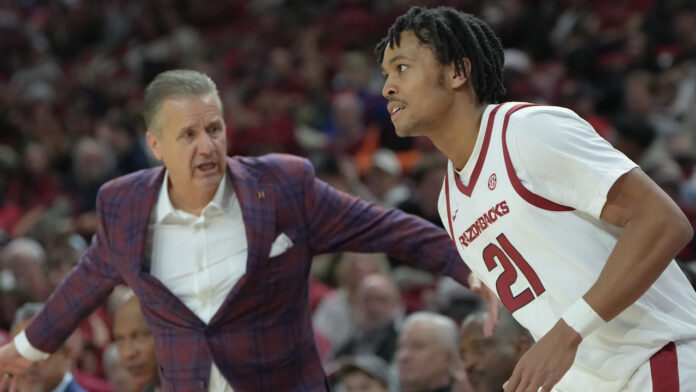
John Calipari said afterward that discipline on both ends mattered most. He noted that Arkansas needed to stay “locked into what we practiced,” and the Razorbacks did just that, from the starters to the final players off the bench.
With all that, the Razorbacks went into the second half looking less for separation and more for consistency.
Razorbacks maintain steady control
Arkansas continued its efficiency after halftime. Though Queens put together a few baskets early in the period, the Hogs responded with strong interior play and timely outside shooting, including a burst from Billy Richmond III.
His personal 7-2 run, capped by an alley-oop slam, brought the crowd to its feet and reminded Queens that Arkansas had more than one player capable of swinging momentum.
Nick Pringle delivered physical presence inside. He worked the glass, cleaned up misses and added second-chance points.

Karter Knox helped push the Razorbacks forward as well, using simple plays — screens, cuts, and rebounds — to keep the pace where Arkansas wanted it.
“We preach taking what the defense gives us,” Pringle said later, and Arkansas followed that message throughout the night.
Whenever Queens overplayed the perimeter, the Hogs cut inside. When the Royals sagged toward the lane, the shooters spotted up and connected from deep.
The Razorbacks never let the lead dip into uncomfortable territory. Defensive rotations stayed sharp, and ball security remained a priority.
Even the small scoring droughts that came in the middle of the second half were handled with patience, not panic.
As the final minutes approached, Arkansas began emptying the bench.
Jaden Karuletwa hit his first collegiate three-pointer, drawing a loud reaction from teammates and fans. For a team focused on building depth and cohesion, moments like that matter.
Ayden Kelley and Amere Brown also closed the game with solid stretches, giving Arkansas a full rotation of players who contributed something meaningful.
What the win means moving forward
The Razorbacks needed a game where they simply handled their business, and this one fits neatly into that category.
Arkansas shot efficiently, defended with effort and showed signs that its offensive spacing and decision-making are trending in the right direction.
With conference play approaching, the Hogs needed confidence, rhythm and proof that their structure holds up regardless of opponent.
This game offered all three. It wasn’t about style points or dramatic swings. It was about doing the job, quarter by quarter, and the Razorbacks did exactly that.
For Calipari, the formula remains steady — defend without fouling, move the ball, create good shots and make the most of the team’s athleticism.
Arkansas followed that script, and it led to a complete performance that should carry into the tougher stretch ahead.
Key takeaways
- Arkansas shot 60 percent from the field and nearly 59 percent from deep in the first half, setting the tone.
- Balanced scoring and bench depth kept the Razorbacks in control from start to finish.
- Defensive pressure forced turnovers that turned into valuable transition points.