










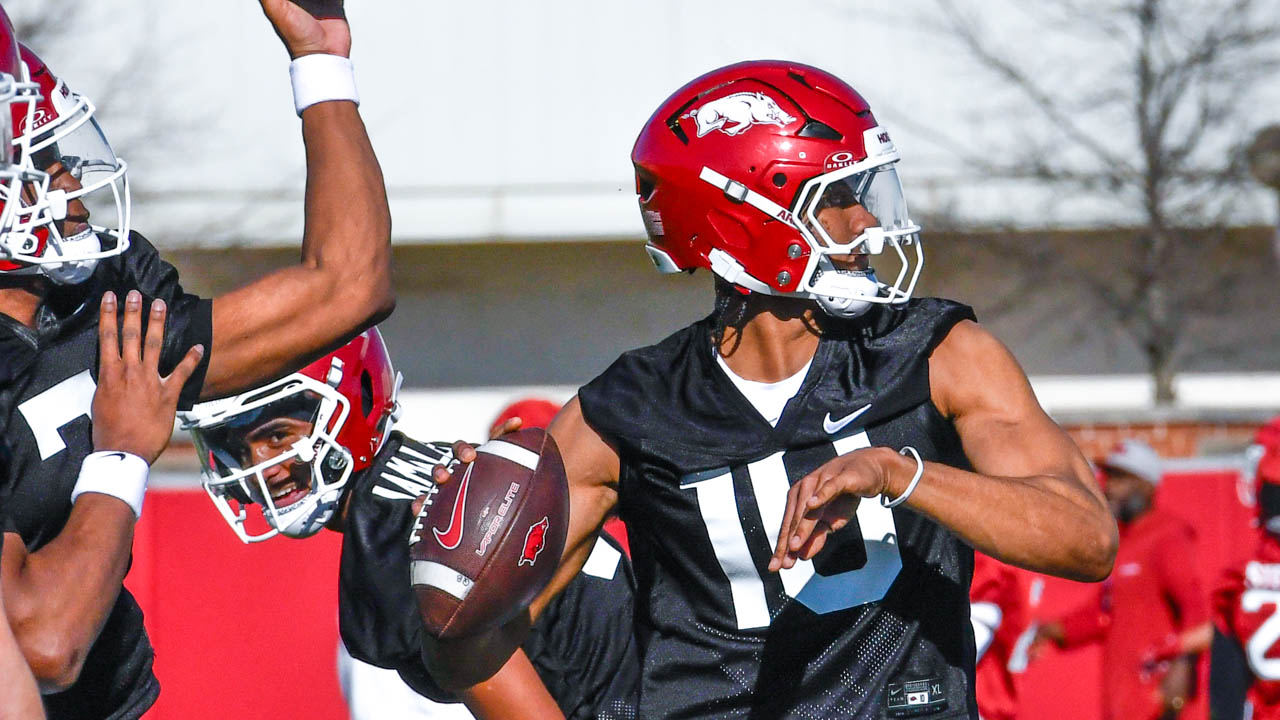
FAYETTEVILLE, Ark. — With the departure of key wide receivers to the NFL and the transfer portal, a retooled offensive line, and a defense built from new faces, much of Arkansas’ success rests on the broad shoulders of quarterback Taylen Green.
Green, a redshirt senior transfer who started at Boise State, returns for a second season under offensive coordinator Bobby Petrino.
Last fall, Green’s debut in the Southeastern Conference was both electric and uneven. He threw for 3,154 yards and 15 touchdowns, but also tossed nine interceptions and finished with a 70.5 QBR, tied for 36th nationally.
His dual-threat capabilities with 602 rushing yards and eight touchdowns on the ground kept Arkansas’s offense alive even as the team struggled through growing pains.
There’s little mystery about who will take the first snap when the Hogs open against Alabama A&M on August 30. Green is the undisputed starter, and he’s entering the season with a new level of comfort in Petrino’s complex system.
“My confidence level is higher because it’s my second year in the offense,” Green said during spring practice. “Just where I was last year, my eyes was like, ‘Oh,’ with the offense and getting on the same page with Petrino and the different plays in the run game and different responsibilities I had to do.
“So I would say my confidence level is higher, but at the same time, I’ve got a lot to get better at and that’s what I’m really focused on. I’m not really content.”
While Green’s athleticism and arm strength are undeniable, his accuracy and pocket presence remain works in progress. Arkansas’s offensive line, rebuilt through the transfer portal, allowed 26 sacks last season, often forcing Green to improvise.

Petrino, renowned for developing quarterbacks throughout his career, has made cutting down turnovers and improving efficiency two pillars of Green’s offseason development.
“If you look at the best quarterbacks in the country, they know where to go with the ball and they get it out quick,” Petrino told reporters in the spring. “Taylen has all the tools, but what we’re working on is making those decisions faster, reading defenses quicker, and trusting the protection up front.”
Behind Green, the depth chart is youthful and largely untested. Redshirt freshman K.J. Jackson is the presumptive backup, having seen only mop-up duty last season.
“KJ’s been stepping up in the role that he has,” Green said in March. “Being my last year, I have to make sure that anybody after me that’s going to take the ropes, that’s what I’m really big on, just leaving this place better than what I found it.”
Florida State transfer Trever Jackson and true freshman Grayson Wilson round out the quarterback group, but unless disaster strikes, neither is expected to see the field in meaningful minutes.
The biggest question for Arkansas’s offense isn’t just about who’s throwing the passes, but who’s catching them.
After losing Andrew Armstrong, Isaac TeSlaa, and Tyrone Broden to the NFL and watching Isaiah Sategna and Dazmin James exit via the transfer portal, the Razorbacks had to rebuild their receiving corps nearly from scratch.
Hogs oach Sam Pittman mined the transfer portal to bring in a diverse group of talent. Among the new faces are Fresno State’s Raylen Sharpe, Charlotte’s O’Mega Blake, Alabama-Birmingham’s Kam Shanks, Stanford’s Ismael Cisse and Florida State’s Jalen Brown.

Blake, coming off a junior season with 795 yards and nine touchdowns, is expected to make an immediate impact.
Sharpe, who previously played for Petrino at Missouri State, says the transition to Arkansas’s playbook has been smoother than expected.
“To be honest, I didn’t know I knew the playbook that well,” Sharpe said this spring. “When they started speaking it again, it all came back to my memory. They’ve got some new stuff that I’ve got to get a grasp on, but everything else has been pretty good.”
For Green, developing chemistry with an almost entirely new receiver corps is the challenge that will define his legacy.
“It’s about trust,” he said during a summer media session. “These guys are hungry. We’re all learning together, and I have to be the one to set the tempo, to let them know that mistakes are opportunities to get better. We’re going to build something here.”
There’s reason for cautious optimism. Arkansas’s offense showed flashes last season, especially in the run game, and a year-two jump under Petrino’s tutelage is a well-trodden storyline in Fayetteville.
During Petrino’s first tenure with the Razorbacks, quarterback Ryan Mallett blossomed in his second year, leading the team to a Sugar Bowl appearance.
While comparing Green to Mallett may be a stretch right now, the expectation for improvement is ever-present.
The Razorbacks’ hopes of a bowl berth and perhaps another upset like they had against Tennessee, hinge on Green’s growth and the ability of his new weapons to make plays in big moments.
The coaching staff’s focus during fall camp will be on continuity and precision, hoping to iron out the miscommunications that plagued the offense last year.
In the huddle, Green’s quiet leadership is earning respect.
“I’ve seen him grow so much, not just as a player but as a person,” said offensive lineman Corey Robinson. “He’s the guy we look to when things get tough. He’s put in the work, and it’s showing.”
The Razorbacks’ quarterback room, has a clear leader and a plan for the future. Whether that plan translates to wins in the SEC remains to be seen.
For Green the stakes are both personal and will affect his future.
A strong season could vault him into national conversation and, perhaps, the NFL Draft. For Arkansas fans, battered by years of roster churn and heartbreak, hope is measured in incremental progress and flashes of brilliance.
But hope is about all the Hogs’ really have this year heading into Media Days again.